Mushroom Guide
Which Mushroom Do You Actually Need?
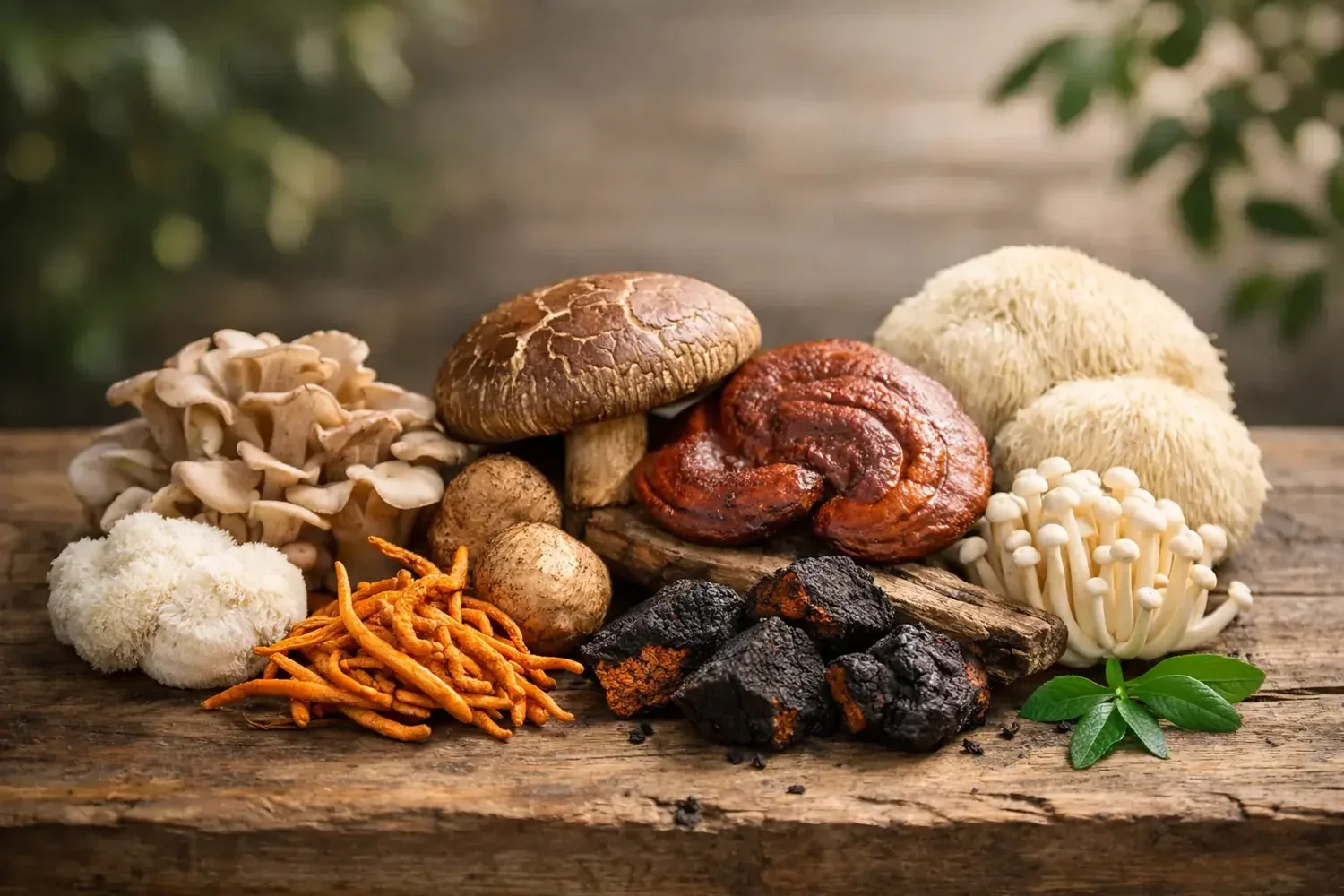
By the end of my taste test, twelve days each on five mushroom coffees, I could tell you which ones tasted like coffee and which ones tasted like a wet log, and which ones left me calm instead of jittery. What I couldn’t tell you was what the six mushrooms listed on the back of a pouch were each doing in there.
Six mushrooms in one scoop isn’t generosity. It’s a brand covering every reason you might have walked in. Which one you came for depends on what’s actually wrong with your day: a scattered head, a tired body, bad sleep, or a cold you can’t shake off.
What a functional mushroom is
Functional mushrooms are mushrooms taken for benefits beyond basic nutrition. They contain adaptogens, which are compounds found in plants and fungi associated with helping the body respond to and regulate stress, and bioactive compounds, the wider group linked to relaxation, immune support and general wellbeing.
The compounds worth knowing by name:
- Beta-glucans. Complex carbohydrates associated with immune support. The most important compound in the category, and the one a product either has or doesn’t.
- Cordycepin. The cordyceps compound. It comes up around heart health, stress and inflammation.
- Triterpenes. The bitter fraction, associated with inflammation and antioxidant activity. Reishi carries far more of them than anything else, which is why reishi tastes the way it does.
- Ergosterol. A sterol that converts into vitamin D under UV light.
Functional is not medicinal
The two words get used as if they were the same thing, and they aren’t. Functional mushrooms are legal, need no prescription, sit in grocery stores, and can go in a pan. Medicinal mushrooms are a separate category. In some places they are heavily regulated and not available without a prescription. They contain different compounds, they act on the body differently, and the research on them is at an earlier stage.
The seven you’ll see on a label

Lion’s mane. For the day your head won’t hold a thought. You read the same paragraph three times, twelve tabs open and nothing finished, the sentence evaporating halfway through. The body is fine, the head is not. It’s associated with focus and mental clarity, and it’s what people reach for when they want to feel sharp without feeling wired. Daytime, morning or early afternoon, around work or studying.

Reishi. For wired and tired. Exhausted all day, then fully alert at eleven at night, lying there with the whole day replaying on a loop, then waking up as though you never slept at all. Reishi is the one most associated with calm, sleep and immune support. Evening only. In a morning cup it works against you.

Cordyceps. For a body running on empty while the mind is fine. The stairs feel like work, you fade halfway through a session, the legs quit long before the motivation does. Cordyceps is talked about for stamina and endurance rather than for a buzz, which is why athletes take it before training. Morning or pre-workout, never evening.

Chaga. For when nothing is wrong exactly and you’re just flat. No single complaint to point at, no obvious thing to fix, you’re simply running at eighty percent most days. Chaga comes up around antioxidants, digestion, skin and the general inflammation conversation. It isn’t a mushroom for one specific afternoon. It’s a daily baseline, taken over months, with no fireworks expected.

Turkey tail. For the person who catches everything going round. Kids back at school, half the office coughing, and whatever everyone else shakes in three days takes you two weeks. Turkey tail is associated with immune support and gut health, which come up together because the two are closely linked. Cold season is its moment, taken daily through the whole of it.

Shiitake. For when you’re not ill, you’ve just started paying attention to the heart side of things, and you’d rather get it from dinner than from a capsule. Shiitake is associated with heart and cholesterol support, and it’s the one on this list that’s actual food. Buy it in the produce aisle and cook it. Start in a stir fry.

Maitake. For the energy rollercoaster. Fine at nine, flattened an hour after lunch, fine again by four, and you plan your afternoon around it. Maitake is associated with immune support, and it’s the one that comes up around blood sugar and blood pressure support. Less famous than the rest, and in plenty of blends regardless, so check the label before you go shopping for it.
Which one is yours
- Scattered, unfocused, can’t settle into work: lion’s mane, daytime.
- Bad sleep, or wired and tired at night: reishi, evening.
- Physically drained, no stamina: cordyceps, morning or pre-workout.
- Run down, catching everything going around: turkey tail.
- Nothing specific, just want one daily mushroom: chaga.
- Gut and immunity together: turkey tail, with chaga underneath it.
- Want to eat mushrooms like a normal person: shiitake, from the produce aisle.
Most blends hand you several at once, which is fine, as long as you know which one you’re there for. If you bought a blend hoping to sleep better and it’s mostly cordyceps, no amount of dosing fixes that.
The label check
Beta-glucans are far more concentrated in the fruiting body, the mushroom part you’d recognize, than in the mycelium, the root-like network underneath.
A lot of products are mycelium grown on grain, and the grain ends up in the powder with it. You’re paying mushroom prices for starch.
So look for the words “fruiting body” on the label. If a brand doesn’t say it, assume there’s a reason. “Mycelial biomass,” “cultured on organic oats,” anything that describes the growing medium instead of the mushroom, treat as a flag. It takes four seconds and it’s the difference between a product worth the money and one that isn’t.
What to expect from any of it
This is gentle, long-horizon stuff. Antioxidants, immune support, steadier energy, the sort of thing you might notice over a season rather than over a Tuesday. Promising is not the same as proven, and anyone promising you a miracle is overselling, so dock them for it.
The practical part: pick one you actually enjoy drinking. Nobody sticks with a cup they resent, and you need months, not a week, to find out whether it’s doing anything at all. A mushroom coffee that tastes good gets drunk every morning. A worthy one that tastes like dirt sits in the cupboard, and then it doesn’t matter what was in it.