Coffee & Gut
Coffee on a Sensitive Stomach: What Actually Helps
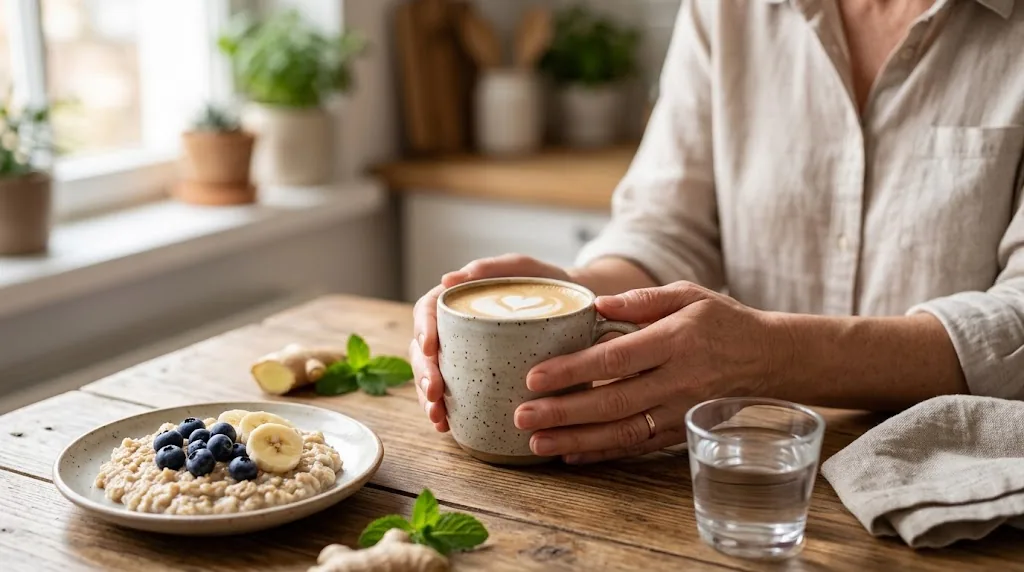
You love the first sip. It’s twenty minutes later that’s the problem: a burning feeling under your ribs, a sour taste, a stomach that feels queasy and unsettled, or a sudden urgent need for the bathroom. Some days it’s mild, some days it ruins the morning, and you’ve started to wonder whether you just have to give coffee up.
Usually you don’t. “Coffee upsets my stomach” tends to come down to a handful of specific things, and most of them can be changed without giving up the cup.
What’s actually going on
Coffee does three things to your gut at once.
It’s acidic, and it also prompts your stomach to make more acid of its own. It stimulates your digestive tract, so your stomach and colon both get moving faster. And it’s often carrying other things in with it, from milk to syrups to sweeteners.
Which of those is bothering you decides which fix will work. Burning and sourness point to acid. Cramping and urgency point to stimulation. Gas and a heavy, bloated feeling often point to what’s added. I went through that last one in detail in why does coffee make me bloated.
The acid: what helps and what’s mostly marketing
Lower-acid coffee. This is the first thing worth trying if burning or sourness is your issue. Some coffees are sold specifically as low-acid, and plenty of people with sensitive stomachs find them noticeably easier.
Darker roasts. In a small study of nine healthy volunteers, a dark roast blend triggered less stomach acid than a regular medium roast, even with similar caffeine. The researchers linked it to a compound that forms during longer roasting. Small study, but it matches what a lot of people notice.
Cold brew. This one gets oversold. When researchers compared cold brew and hot coffee made from the same beans, the pH was about the same. Cold brew did have fewer total acids, which is why it tastes smoother, so some people do find it easier. Just don’t expect it to be a different drink as far as your stomach is concerned.
Decaf. Decaf still prompts some acid, so it isn’t a guaranteed fix. But it takes the caffeine part out of the picture, and for some people that’s the bigger half.
The caffeine
Caffeine is a big part of what speeds your gut up, and it adds up fast. A regular 8oz cup of brewed coffee has around 80 to 100mg. A large coffee shop drink can have two or three times that.
You don’t have to quit to feel the difference. One smaller cup instead of a big one, half-caf, or a coffee with less caffeine per serving is often enough to take the edge off the cramping and the rush to the bathroom.
Timing makes a bigger difference than you’d think
Not on an empty stomach. With nothing else to work on, the acid and the stimulation hit an empty stomach directly. Having your coffee with breakfast, or even after a few bites of something, is the single easiest change for a lot of people.
Slow down. Sipping over twenty minutes is gentler than downing a mug on the way out the door.
Watch the afternoon cup. If your stomach is fine in the morning but rough by mid-afternoon, the second or third coffee is usually the one to cut.
What you put in it
Milk can go either way. For some people a splash of milk softens coffee and makes it easier to drink. For others, the lactose is the actual problem, and a stomach that “can’t handle coffee” turns out to handle black coffee perfectly well.
Syrups, sugar-free creamers and coffees with added fiber can all bring their own problems, so if you’ve tried everything else, try your coffee with nothing in it for a week.
If it’s reflux
If what you feel is heartburn, a burning that rises up your chest, especially after meals or when you lie down, that’s reflux. Coffee is a common suspect, but the evidence on it is genuinely mixed, and current gastroenterology guidance leans toward finding your own triggers rather than cutting coffee out for everyone. Keep notes, test one change at a time, and if heartburn is happening more than a couple of times a week, see your doctor about it.
What to try, in order
Give each one about a week, and keep a quick note of how your stomach feels an hour after your coffee.
- Have your coffee with food, not on an empty stomach.
- Drink it with nothing added, or only with a milk you know agrees with you.
- Cut the size or the caffeine: one cup, smaller, or a lower-caffeine coffee.
- Switch to a low-acid coffee or a darker roast.
If you’re looking at a mushroom coffee as an alternative, the same rules apply. Look for one made with low-acid coffee, with the caffeine listed in milligrams and lower than what you drink now, and nothing in the ingredient list that doesn’t need to be there. I wrote up what else to check in 5 things to check before you buy mushroom coffee.
When to see a doctor
Stomach pain that’s frequent or severe, trouble swallowing, vomiting, black or bloody stools, or weight loss you can’t explain are not coffee problems to experiment with. They’re a reason to get checked.
Sources
- Rubach et al. (2014). A dark brown roast coffee blend is less effective at stimulating gastric acid secretion in healthy volunteers compared to a medium roast market blend. Molecular Nutrition & Food Research.
- Rao & Fuller (2018). Acidity and antioxidant activity of cold brew coffee. Scientific Reports.
- Katz et al. (2022). ACG clinical guideline for the diagnosis and management of gastroesophageal reflux disease. American Journal of Gastroenterology.
- NIDDK, National Institutes of Health. Definition & facts for lactose intolerance.
- U.S. FDA. Spilling the beans: how much caffeine is too much?