Buying Guide
5 Things to Check Before You Buy Mushroom Coffee
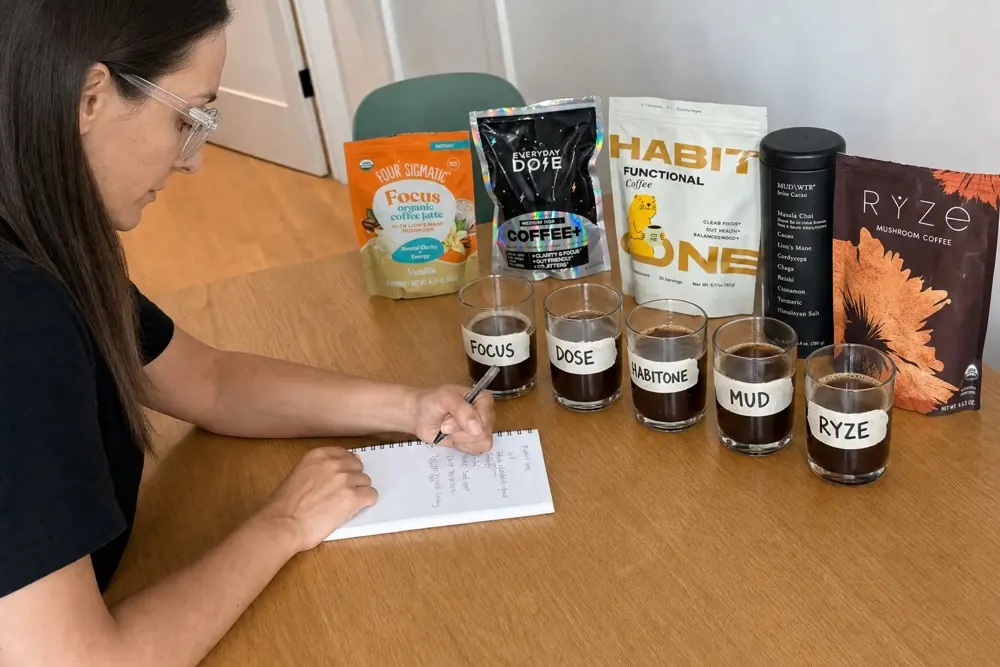
Almost every mushroom coffee says lion’s mane on the front. Some have a decent amount of it inside. Some have a sprinkle, some have something that only technically counts, and some make it genuinely hard to tell. The front of the pouch won’t tell you which one you’re holding.
These are the five things that actually matter, in the order I’d check them.
1. Which part of the mushroom is in it
A mushroom has two parts. The fruiting body is the mushroom you’d recognize, the cap and stem. The mycelium is the root-like network underneath it. Both can legally go on a label as “lion’s mane”.
The problem is how mycelium is usually grown for supplements: on grain, most often oats or brown rice. The mycelium and the grain can’t be separated afterwards, so the whole thing gets dried, milled and sold together. Lab testing published by one extract supplier, across roughly a hundred commercial samples, found that mycelium-on-grain products averaged 35 to 40% starch by dry weight. Their reishi fruiting body came in at around 28% beta-glucans and almost no starch. Reishi mycelium samples sat between 1 and 7% beta-glucans and roughly half starch.
That supplier sells fruiting body extracts, so read it with that in mind. Brands that use mycelium argue it carries compounds of its own, and that’s a fair point. But if a third of what you paid for is oats, that’s not a debate about mushrooms anymore.
What to look for: the words “fruiting body” on the label. If you see “mycelium”, “myceliated”, “full spectrum” or “cultured on organic oats”, grain is probably part of the scoop.
2. An amount next to every mushroom
This is the one that caught me out the most. In the US, a supplement can group its ingredients into a “proprietary blend” and only list the total weight of the blend. The individual amounts don’t have to be on the label at all, just the order from most to least. Some brands still publish them on their product page, plenty don’t publish them anywhere.
So a pouch can say 2,000mg blend, list six mushrooms, and the last four could be there in amounts too small to matter. You’d have no way of knowing.
Why it matters: the research people quote is done at real doses. The lion’s mane study you’ll see cited most, from Japan in 2009, gave older adults with mild memory decline about 3 grams of dried fruiting body powder a day for 16 weeks. Their scores improved, and slipped back once they stopped. You don’t need to match a clinical trial with your coffee, but a few hundred milligrams split six ways is a very different thing from what was studied.
Two more things on this label:
- Extract or powder. They’re not interchangeable. An extract is concentrated, so the same number of milligrams can mean different things. Good labels say which one each mushroom is.
- More is not automatically better. Chaga in particular is very high in oxalates, and there are case reports of kidney problems in people taking large amounts of chaga powder, around 10 to 15 grams a day, for months. A cup of mushroom coffee is nowhere near that, but if you’ve had kidney stones, it’s worth a word with your doctor.
What to look for: a number in milligrams for each mushroom, on the label or on the brand’s site, and whether it’s an extract or a powder.
3. Don’t be impressed by “polysaccharides”
Beta-glucans are the compounds most of the mushroom research centers on, and they’re the reason a fruiting body extract costs more than a bag of oats. The catch is that a lot of brands advertise “polysaccharides” instead. Starch is a polysaccharide too. So a product that’s mostly grain can post a big polysaccharide number and still have very little of what you were paying for.
This isn’t a hypothetical. When researchers tested 19 reishi supplements bought in the US in 2017, only 5 matched what was on their labels, and most of the ones that failed had a starch-like profile that didn’t look like reishi at all.
How the mushroom was extracted matters here as well. Mushroom cell walls are tough, which is why most research uses hot-water extracts rather than raw powder. Reishi and chaga are often dual extracted, water and then alcohol, because some of their compounds only come out the second way.
What to look for: if a brand leans on a big polysaccharide number, ask what share of it is beta-glucans. Fruiting body and the extraction method tell you more than that number does.
4. Proof that it was actually tested
Mushrooms are very good at absorbing whatever is in the ground they grow on, including heavy metals like lead and cadmium. How much ends up in the final product depends on the species and, a lot, on where it was grown. Coffee has its own issue: a mold toxin called ochratoxin A. One study of 57 roasted coffees from nine countries found it in about half of them, mostly at low levels, with five over the EU limit.
None of that is a reason to panic. It’s a reason to want to see the test.
“Third-party tested” printed on a pouch costs nothing. What you want is a certificate of analysis, or COA, from an independent lab, ideally matched to your batch. A brand that’s proud of its testing will usually link it right on the product page. It should cover heavy metals, mold and mycotoxins, and pesticides.
What to look for: a COA you can actually open, not just a badge.
5. The caffeine number and the real price per cup
Two numbers people skip, and both decide whether you’ll still be drinking it in a month.
Caffeine. According to the FDA, an 8oz cup of brewed coffee has around 80 to 100mg of caffeine, and 400mg a day is the general ceiling for healthy adults. Mushroom coffees are all over the place. Some are cacao or chai based with around 35mg, which can feel like nothing if you’re used to two cups. Others have close to a full cup. “Half the caffeine” on the front of a pouch is a claim. The milligrams on the back are the answer.
Price. Work it out at the dose the brand actually recommends. If the directions say two scoops a cup, a 30 serving bag is really 15 cups, and the price per cup doubles.
What to look for: caffeine in milligrams, and servings per bag at the recommended dose.
The short version
Before you buy, check the label and the product page for:
- “Fruiting body”, not mycelium on oats or rice
- A milligram amount for every mushroom, not just a blend total
- Real numbers, not just a big “polysaccharides” figure
- A COA from an independent lab you can actually open
- Caffeine in milligrams, and the price per cup at the dose they recommend
If a brand ticks all five, you’re at least drinking what you think you’re drinking. Which mushrooms you actually want in there is a separate question, and I went through that one mushroom by mushroom in which mushroom do you actually need.
Sources
- Gonzales, M. The functional mushroom label problem and three questions that settle it (Nammex lab data). Vegconomist.
- Wu et al. (2017). Evaluation on quality consistency of Ganoderma lucidum dietary supplements collected in the United States. Scientific Reports.
- Mori et al. (2009). Improving effects of the mushroom Yamabushitake (Hericium erinaceus) on mild cognitive impairment. Phytotherapy Research.
- U.S. FDA. 21 CFR 101.36, Nutrition labeling of dietary supplements (proprietary blends).
- Kwon et al. (2022). Chaga mushroom-induced oxalate nephropathy that clinically manifested as nephrotic syndrome: a case report. Medicine.
- Heavy metals and associated risks of wild edible mushrooms consumption (2024). Journal of Fungi.
- ConsumerLab. Is it true that most coffee is contaminated with mold?
- U.S. FDA. Spilling the beans: how much caffeine is too much?