Ingredient Guide
Lion's Mane: What the Research Actually Says
You walk into the kitchen and forget why. You read the same paragraph three times. A word you use every day is suddenly just gone, right in the middle of a sentence. If that’s been happening more than it used to, lion’s mane is probably the name you’ve seen most, usually next to the phrase “brain mushroom” and a promise that sounds too good.
So I went through the actual human studies. There are fewer of them than the marketing would suggest, and they’re smaller, but some of what they found is genuinely interesting.
What lion’s mane is
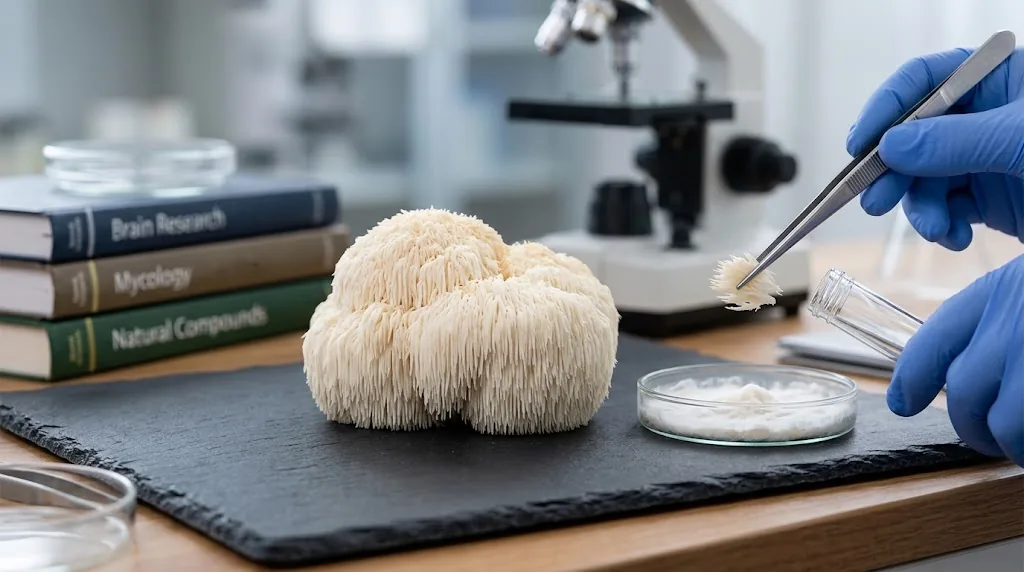
Lion’s mane is an edible mushroom that grows on hardwood trees. It looks like a white, shaggy pompom, or a frozen waterfall of soft spines, which is where the name comes from. In parts of East Asia it’s been eaten and used for a very long time. Cooked, it has a mild, slightly seafood-like texture.
What makes it interesting to researchers is two groups of compounds found almost nowhere else.
- Hericenones, found in the fruiting body, the part of the mushroom you’d recognize.
- Erinacines, found in the mycelium, the root-like network the mushroom grows from.
In lab studies, both stimulate the production of nerve growth factor, a protein your body uses to maintain and repair nerve cells. That’s the whole reason lion’s mane gets linked to memory and focus. It’s worth being clear that this part of the story comes from cells in a dish and from animals. The human evidence is a separate, smaller thing.
What the human studies found
Memory in older adults. The study you’ll see quoted most is from Japan in 2009. Thirty adults aged 50 to 80 with mild cognitive impairment took about 3 grams a day of dried lion’s mane fruiting body powder, or a placebo, for 16 weeks. The lion’s mane group’s scores on a cognitive test improved at 8, 12 and 16 weeks. Four weeks after they stopped, the scores slipped back down.
A later Japanese study, in 2019, gave healthy adults over 50 lion’s mane fruiting body supplements for 12 weeks. Scores on one of the three memory tests improved compared with placebo. The other two moved in the right direction without reaching significance.
Focus and speed in younger adults. A 2023 UK study gave healthy 18 to 45 year olds 1.8 grams of lion’s mane. An hour after a single dose they were a bit quicker on an attention task, and after 28 days there was a trend toward lower stress. The researchers were careful to call it a pilot study with tentative results, and some measures didn’t change.
Mood and anxiety. A small 2010 study had 30 women eat cookies with 2 grams of lion’s mane fruiting body powder a day, or placebo cookies, for four weeks. Their depression and general complaint scores dropped compared to before, and feelings like irritability and anxiety tended lower than the placebo group.
What that adds up to
Put together, the human research suggests lion’s mane may help with memory in older adults with early decline, and may help a little with focus, mood and stress in healthy people. Every study is small, most are short, and several came from a small number of research groups.
That’s not nothing. It’s also not “the mushroom that rewires your brain”. If you see a product promising that, they’re selling the lab studies, not the human ones.
How much, and for how long
The human studies used somewhere around 1.8 to 3 grams a day, mostly as whole fruiting body powder, the same part of the mushroom you’d find at a farmer’s market. Most of the memory results took weeks to show up, typically 8 to 16, and faded after people stopped.
Two practical takeaways from that:
- Consistency matters more than any single cup. Lion’s mane looks like something you take daily for months, not something you try for a weekend.
- Know what you’re getting. A lot of products bury lion’s mane inside a proprietary blend, so you can’t see the amount. Look for the milligrams listed and the words “fruiting body”. In a coffee, it’s a daily contribution rather than a clinical dose, which is fine as long as you know that going in.
I went through what to look for on a label in 5 things to check before you buy mushroom coffee, and how quickly to expect anything in how long does mushroom coffee take to work.
Is it safe?
Lion’s mane is a food mushroom and the studies reported it as well tolerated, with occasional mild stomach upset. A small number of people are allergic to it, which usually shows up as a skin reaction or breathing trouble, and if that happens you should stop. Because there’s very little research in pregnancy, and some suggestion it could interact with blood thinners or diabetes medication, it’s worth checking with your doctor if either applies to you.
Who it actually suits
Lion’s mane makes the most sense if your main complaint is your head rather than your body: scattered focus, losing your train of thought, that foggy, slow feeling that coffee alone doesn’t fix. It’s a poor fit if you want to feel something dramatic tomorrow morning.
If you’re weighing it against the other common mushrooms, I compared them side by side in which mushroom do you actually need.
Sources
- Mori et al. (2009). Improving effects of the mushroom Yamabushitake (Hericium erinaceus) on mild cognitive impairment. Phytotherapy Research.
- Saitsu et al. (2019). Improvement of cognitive functions by oral intake of Hericium erinaceus. Biomedical Research.
- Docherty et al. (2023). The acute and chronic effects of lion's mane mushroom supplementation on cognitive function, stress and mood in young adults. Nutrients.
- Nagano et al. (2010). Reduction of depression and anxiety by 4 weeks Hericium erinaceus intake. Biomedical Research.
- American Botanical Council / Restorative Medicine. Lion's mane monograph (hericenones and erinacines).