Buying Guide
Mushroom Coffee vs Regular Coffee: An Honest Comparison
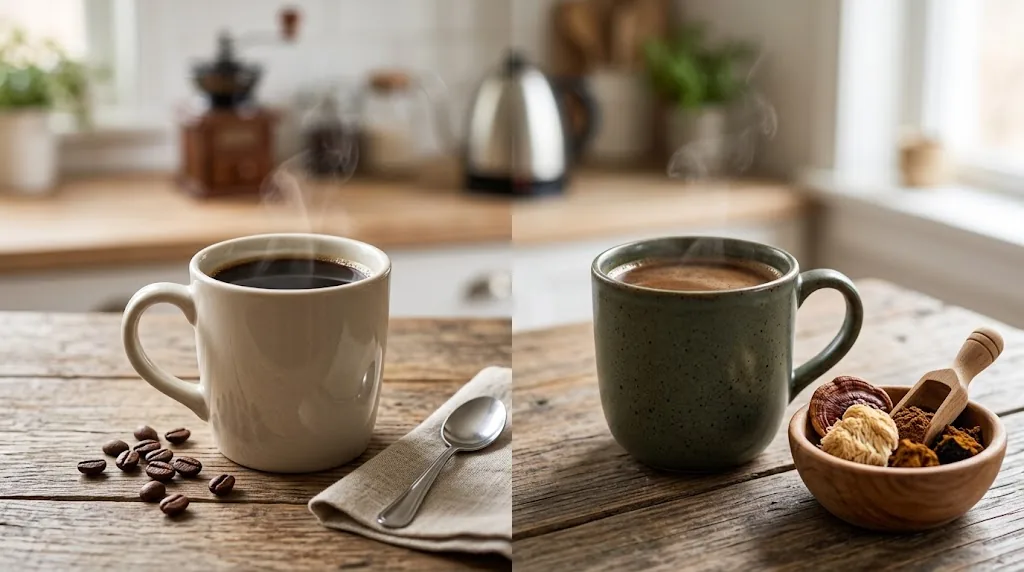
Mushroom coffee gets sold as an upgrade, and regular coffee gets talked about like it’s a bad habit you should be ashamed of. Neither of those is really true. They’re different drinks that suit different people, and the right one for you depends mostly on what your current coffee is doing to you.
Here’s how they actually compare, point by point.
First, regular coffee isn’t the villain
It’s worth saying up front, because a lot of mushroom coffee marketing skips it. Coffee on its own has a lot going for it. A large BMJ review pulled together over 200 analyses of coffee and health, and found that people drinking three to four cups a day tended to have lower risk of a range of conditions than people who didn’t drink it at all. Those are observational studies, so they show a link rather than proof, but the overall picture is that for most healthy adults, moderate coffee is more likely to help than harm. Pregnancy is the main exception.
So the question isn’t whether coffee is bad for you. It’s whether your coffee is working for you.
What’s actually in the cup
Regular coffee is coffee. Beans, water, and whatever you add.
Mushroom coffee is a much looser category. Most are instant coffee blended with powdered mushroom extracts, usually lion’s mane, chaga, cordyceps or reishi. Many add other things too: adaptogens like rhodiola, amino acids for focus, collagen, or prebiotic fiber. And some of the best-known “mushroom coffees” don’t contain coffee at all. They’re built on cacao, chai or black tea instead.
That last point matters more than people realize. If you love coffee, a mushroom drink with no coffee in it is a different experience entirely, not a swap.
Caffeine
An 8oz cup of brewed coffee has around 80 to 100mg of caffeine, and a large coffee shop drink can be two or three times that.
Mushroom coffees range widely. The cacao and chai based ones can be as low as 35mg, which feels like very little if you’re used to a real cup. Ones built on actual coffee tend to land somewhere between that and a regular cup, often less than what you’d get from a big mug at home.
The honest take: a lot of what people feel when they switch is simply less caffeine per cup. That’s not a knock on mushroom coffee, it’s just worth knowing. If you want to still feel your coffee, pick one built on real coffee with the caffeine listed in milligrams.
Taste
Regular coffee wins on range. Light roast, dark roast, espresso, pour-over, cold brew, every bean and every café.
Mushroom coffee is hit and miss. The better ones taste like a smooth instant coffee and you’d struggle to pick the mushrooms out. The worse ones taste earthy, muddy or bitter, and some leave a gritty layer at the bottom of the mug. The ones without coffee taste like spiced cacao or chai, which some people love and coffee lovers usually don’t.
Your stomach
Coffee stimulates stomach acid and gets your gut moving, which some people barely notice and others feel within twenty minutes. If you’re in the second group, the things that help are less caffeine per cup, lower-acid coffee, and nothing added that your gut doesn’t like. A mushroom coffee made with low-acid coffee and no added fiber or sweeteners can be gentler. One loaded with inulin or sugar alcohols can be worse. I went through the details in why does coffee make me bloated.
The jitters and the crash
This is the biggest reason people switch, and it’s mostly about dose. Big cups of strong coffee, especially on an empty stomach, are what tend to cause the shaky, anxious edge and the slump a few hours later. A cup with less caffeine, plus things like adaptogens that don’t act like stimulants, gives a lot of people steadier energy through the morning.
You can get part of the way there with regular coffee too: a smaller cup, half-caf, coffee with breakfast, and nothing after early afternoon.
What the mushrooms actually add
Here’s where I’d be careful. There’s real research on functional mushrooms like lion’s mane, but it’s mostly done at doses of a gram or more a day, often with extracts, over weeks or months. Many mushroom coffees contain far less than that per serving, and some hide the amounts in a proprietary blend.
So treat the mushrooms as a bonus, not the main event. If they matter to you, check that it uses the fruiting body of the mushroom, lists the amounts, and shows independent testing. I wrote up exactly what to check in 5 things to check before you buy mushroom coffee, and what each mushroom is for in which mushroom do you actually need.
Price per cup
Coffee you brew at home is the cheapest option by far, often well under fifty cents a cup. A coffee shop drink is several dollars.
Mushroom coffee sits in between, usually around one to two dollars a cup. Work it out at the dose the brand recommends, because some ask for two scoops per cup, which halves how long a bag lasts. Compared with a daily coffee shop habit it’s often cheaper. Compared with a bag of beans at home, it isn’t.
So which one should you drink?
Stick with regular coffee if it doesn’t bother you. If you sleep fine, your stomach’s fine, you don’t crash and you love the taste, there’s no good reason to switch.
Mushroom coffee is worth trying if you love coffee but it’s started to love you back a little less: the jitters, the anxious edge, the afternoon crash, a stomach that complains, or you just want less caffeine without quitting coffee altogether.
If you do try one, look for real coffee as the base, a caffeine number you’re comfortable with, low acid if your stomach is sensitive, fruiting body mushrooms with the amounts listed, nothing added that doesn’t need to be there, and a price per cup that still makes sense at the recommended dose. Give it a couple of weeks before you decide, because the first few days mostly tell you whether you like the taste.
Sources
- Poole et al. (2017). Coffee consumption and health: umbrella review of meta-analyses of multiple health outcomes. BMJ.
- Mori et al. (2009). Improving effects of the mushroom Yamabushitake (Hericium erinaceus) on mild cognitive impairment. Phytotherapy Research.
- Rubach et al. (2014). A dark brown roast coffee blend is less effective at stimulating gastric acid secretion. Molecular Nutrition & Food Research.
- U.S. FDA. Spilling the beans: how much caffeine is too much?